- English
- French
- German
- Portuguese
- Spanish
- Russian
- Japanese
- Korean
- Arabic
- Greek
- German
- Turkish
- Italian
- Danish
- Romanian
- Indonesian
- Czech
- Afrikaans
- Swedish
- Polish
- Basque
- Catalan
- Esperanto
- Hindi
- Lao
- Albanian
- Amharic
- Armenian
- Azerbaijani
- Belarusian
- Bengali
- Bosnian
- Bulgarian
- Cebuano
- Chichewa
- Corsican
- Croatian
- Dutch
- Estonian
- Filipino
- Finnish
- Frisian
- Galician
- Georgian
- Gujarati
- Haitian
- Hausa
- Hawaiian
- Hebrew
- Hmong
- Hungarian
- Icelandic
- Igbo
- Javanese
- Kannada
- Kazakh
- Khmer
- Kurdish
- Kyrgyz
- Latin
- Latvian
- Lithuanian
- Luxembou..
- Macedonian
- Malagasy
- Malay
- Malayalam
- Maltese
- Maori
- Marathi
- Mongolian
- Burmese
- Nepali
- Norwegian
- Pashto
- Persian
- Punjabi
- Serbian
- Sesotho
- Sinhala
- Slovak
- Slovenian
- Somali
- Samoan
- Scots Gaelic
- Shona
- Sindhi
- Sundanese
- Swahili
- Tajik
- Tamil
- Telugu
- Thai
- Ukrainian
- Urdu
- Uzbek
- Vietnamese
- Welsh
- Xhosa
- Yiddish
- Yoruba
- Zulu
Straight Brace Connecting Plate: Precision CNC Machining for GPU Thermal Management Systems
Modern GPUs power everything from mainstream desktop gaming and professional content creation to lightweight edge AI computing. Yet regardless of core performance or chip architecture, sustained output always comes down to reliable thermal management. Uneven heat distribution, minor assembly gaps, and inconsistent thermal contact are the silent causes of GPU throttling, unstable frame rates, and shortened hardware lifespans. This is where a well-machined Straight Brace Connecting Plate makes all the difference.
Acting as both structural support and thermal bridge between the GPU core and heat sink assembly, this small but critical component directly defines cooling uniformity. Many manufacturers mistakenly chase higher thermal conductivity materials while overlooking machining precision. In reality, flatness consistency and accurate mounting positioning determine how effectively heat transfers across the interface. For overseas mid-to-low-end commercial and industrial GPU equipment, blind ultra-precision full-part machining only raises costs without bringing practical performance gains. Adopting a reasonable tiered tolerance standard based on real equipment capability is the most reliable and cost-efficient production solution.

What Is a Straight Brace Connecting Plate, and Why Does Machining Precision Matter?
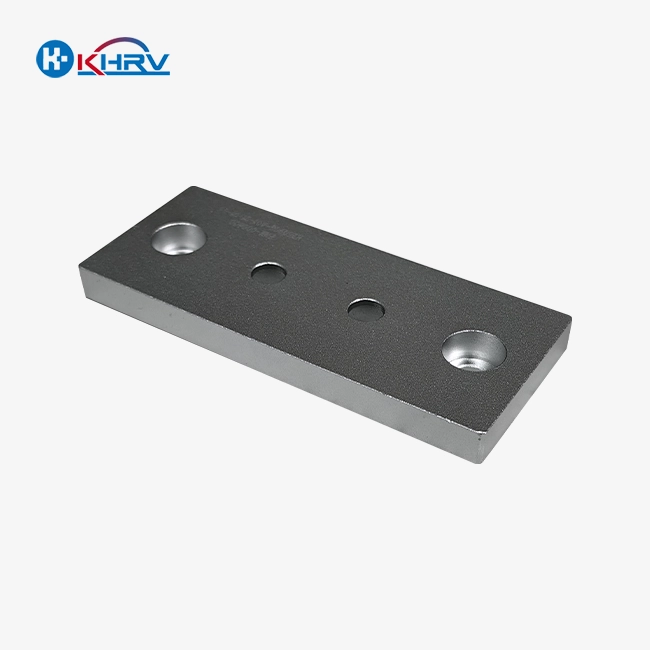
A straight brace connecting plate is a custom CNC-machined thermal structural part exclusively built for GPU heat sink assemblies. It stabilizes the entire cooling module against vibration and long-term thermal cycling fatigue, while creating a continuous, tight-contact heat conduction path between the GPU die and heat sink fins. Even tiny surface unevenness or misaligned mounting holes can create invisible air gaps, trapping local heat and gradually lowering GPU operating efficiency.
Thermal conductivity is a fixed material property. Oxygen-free copper delivers 390–401 W/m·K, while common 6061 and 6063 aluminum alloys offer 96–200 W/m·K conductivity. No machining process can upgrade material thermal performance. What machining does control is how much of that theoretical conductivity actually translates into real cooling effect.
This is why professional manufacturers adopt differentiated precision control rather than uniform high tolerance for every surface. At Wuxi Kaihan, all production relies on mature civilian-grade 3-axis, 4-axis CNC machining centers. Our factory has no five-axis ultra-precision equipment, and our process standards are fully tailored to mid-range overseas market demands and actual machine capability.
We strictly implement core functional precision standards: • Key mounting hole position tolerance: ±0.01mm • Core thermal surface flatness and parallelism: 0.1mm • All non-critical surfaces and auxiliary features:standard industrial tolerances
This tiered approach eliminates unnecessary machining difficulty and scrap rate, ensuring stable thermal contact and assembly accuracy without overengineering for mid-tier GPU application scenarios.
Practical Material Options for GPU Straight Brace Connecting Plates
Material selection should always match actual GPU thermal load, not follow generic industry preference. Each material has its own applicable scenarios, balancing performance, weight and procurement cost.
Oxygen-Free Copper (C10200 / C11000)
Copper is the ideal choice for high-heat-load GPUs, including overclocked gaming graphics cards and entry-level AI computing GPUs. Its ultra-high thermal conductivity quickly disperses concentrated core heat, while excellent structural stability resists thermal deformation under long-cycle high-temperature operation. For equipment that requires stable full-load operation for hours, copper straight brace plates deliver far more consistent thermal output. For cost-sensitive mid-range projects, copper is only recommended for high-TDP core modules rather than full-equipment adoption.
Aluminum Alloy (6061-T6 / 6063-T5)
Aluminum alloys remain the most cost-effective solution for mainstream commercial GPUs, office graphics cards and light-load creative hardware. Lightweight and easy to machine, qualified aluminum plates greatly reduce overall heat sink module weight while meeting daily heat dissipation demands. After hard anodizing treatment(arranged through a certified external supplier), the surface gains strong oxidation and wear resistance, maintaining stable flatness and thermal contact for years of continuous operation. It is the best option for mass-produced mid-to-low-end GPU cooling accessories.
Copper-Aluminum Composite
Composite structures strike a balanced solution: copper layers ensure efficient core heat conduction, while aluminum layers control overall weight and production cost. They are widely used in mid-level customized GPU heat sinks that require both reliable cooling performance and lightweight structural design.
Real Application Cases: Tiered Precision Machining in Mass Production
Our processing strategy is not theoretical. It has been fully verified in batch OEM projects for overseas GPU manufacturers.
Case 1: Copper Straight Brace Plate for Mid-Range Overclocked Gaming GPU
An overseas gaming hardware supplier required C11000 oxygen-free copper connecting plates for their mid-tier overclocked GPU series. The core challenge was maintaining stable thermal contact during repeated temperature cycles from room temperature to 85°C, avoiding local hotspots and frequency drops.
We adopted 4-axis CNC machining for batch production, strictly controlling key mounting holes at ±0.01mm and thermal interface flatness at 0.1mm. All non-essential edges and auxiliary structures followed standard industrial tolerances. Post-processing precision polishing and passivation(both arranged through certified external suppliers) removed surface oxide layers to maximize effective heat conduction area.
The 300-piece batch was completed within 16 working days, with full material certification and dimensional inspection reports. After assembly testing, the customer recorded a 3–5°C drop in peak GPU temperature, with far more stable full-load operation. Meanwhile, our tiered precision scheme helped the client cut unit costs by around 35% compared with fully ultra-precision suppliers.
Case 2: Aluminum Straight Brace Plate for Entry-Level Commercial GPU
For mass-produced entry-level office and light-use discrete GPUs, cost control and batch consistency are the core priorities. We adopted 3-axis CNC machining for 6061-T6 aluminum plates, retaining the same core precision standards: ±0.01mm mounting hole tolerance and 0.1mm flatness on thermal fitting surfaces, with standard industrial tolerances for non-critical areas.
Hard anodizing(arranged through a certified external supplier) guaranteed long-term surface stability against oxidation and friction. The pre-production sample was approved in 4 working days, and the 2,000-piece mass batch was delivered in 14 working days. The customer achieved a 40% cost reduction compared with traditional copper configurations, while keeping GPU operating temperatures fully within factory specifications.
From repeated project verification, our tiered precision processing brings three stable advantages for overseas mid-to-low-end GPU supporting parts: • Core thermal and assembly precision remains fully guaranteed • Machining difficulty and scrap rate are effectively controlled, fitting civilian 3-axis and 4-axis CNC equipment capability • Comprehensive procurement cost drops by 30–40% without sacrificing practical usage performance
Reliable Sourcing Standards for Custom GPU Thermal Components
For thermal design engineers and procurement teams, good component sourcing is not about pursuing extreme parameters, but about finding the most matching solution for product positioning.
Match materials according to actual thermal load. High-TDP overclocked and entry-level AI GPUs suit oxygen-free copper; mainstream commercial and low-power office GPUs perfectly adopt cost-effective aluminum alloy. Avoid blindly using high-end materials to raise redundant costs.
Adopt tiered tolerance matching equipment capability. Functional surfaces related to heat conduction and assembly require strict ±0.01mm hole tolerance and 0.1mm flatness. All decorative and non-load-bearing auxiliary surfaces follow standard industrial tolerances. This processing logic is completely realized on our 3-axis, 4-axis CNC machines, avoiding the high pricing threshold of five-axis ultra-precision manufacturing.
Standardize surface treatment processes. Aluminum plates use hard anodizing(arranged through a certified external supplier) to enhance surface stability; copper plates adopt polishing and passivation(both arranged through certified external suppliers) to ensure lasting thermal conductivity. Every batch comes with complete process and quality documents.
Verify through pre-production sampling. Small-batch sample confirmation effectively avoids batch assembly deviation and thermal performance defects, ensuring consistency in mass production delivery.
Conclusion
GPU heat dissipation performance is never determined by a single material parameter or blind ultra-precision processing. The Straight Brace Connecting Plate delivers stable cooling output through precise control of core functional surfaces and reasonable cost control of non-key structures. Tailored to overseas mid-to-low-end commercial and industrial GPU market positioning, Wuxi Kaihan relies on mature 3-axis, 4-axis CNC machining centers, implementing strict tiered precision standards: key hole positions at ±0.01mm, core flatness and parallelism at 0.1mm, and non-critical surfaces with standard industrial tolerances. With reasonable material selection, standardized surface treatment and stable batch production capacity, we help global customers achieve 30–40% cost optimization while maintaining consistent thermal performance and assembly stability, providing highly cost-effective customized solutions for long-term batch procurement of GPU thermal structural parts.
FAQ
1. What is the main function of a Straight Brace Connecting Plate in GPU cooling systems? The straight brace connecting plate acts as both structural reinforcement and thermal transfer medium for GPU heat sink modules. It stabilizes the overall assembly structure against vibration and thermal cycling deformation, while providing a flat, tight-contact heat conduction interface to evenly export core heat, effectively avoiding GPU overheating and frequency throttling.
2. Should I choose copper or aluminum for GPU straight brace plates? It depends on your GPU’s thermal design power and market positioning. Oxygen-free copper suits high-load overclocked gaming and entry-level AI GPUs that demand strong continuous heat dissipation. Aluminum alloy is ideal for entry-level and mid-range commercial GPUs with strict cost control requirements, offering balanced performance and lightweight advantages.
3. What precision standards do you apply for custom straight brace connecting plates? We adopt tiered precision fully adapted to our civilian CNC equipment and mid-range product positioning. Key mounting holes are controlled at ±0.01mm, core thermal surface flatness and parallelism reach 0.1mm. All non-critical auxiliary surfaces adopt standard industrial tolerances, avoiding excessive processing difficulty and redundant costs.
4. What surface treatments do you provide for copper and aluminum plates? Aluminum alloy plates undergo hard anodizing(arranged through a certified external supplier) to improve surface hardness, wear resistance and oxidation stability. Copper plates are precision polished and passivated(arranged through certified external suppliers) to remove oxide layers, maximizing effective thermal contact area and ensuring long-term stable heat conduction performance.
5. What is your lead time for custom GPU thermal brace plates? Our standard delivery cycle is 10–20 working days, supporting drawing customization, small-batch prototype verification and large-batch mass production with stable and controllable delivery schedules.
6. How can we reduce procurement costs while ensuring GPU cooling performance? Reasonable material matching and tiered precision machining are the core solutions. We focus high precision only on functional surfaces that determine heat dissipation and assembly quality, and adopt standard industrial tolerances for non-key areas, effectively reducing machining difficulty and scrap rates, achieving 30–40% comprehensive cost savings without affecting product practical performance.
Partner with KHRV for Reliable Custom GPU Thermal Management Components
Wuxi Kaihan Technology Co., Ltd. (KHRV) focuses on customized CNC machining of mid-range commercial and industrial GPU heat dissipation structural parts, specializing in high-precision Straight Brace Connecting Plate manufacturing. Our ISO 9001:2015-certified workshop is equipped with mature 3-axis, 4-axis CNC machining centers, with no five-axis ultra-precision equipment. We always formulate processing schemes based on actual equipment capabilities and overseas mid-to-low-end market demands.
We provide full OEM non-standard customization services, covering material selection, structural optimization, precision tolerance matching and surface treatment customization(coordinated with accredited external suppliers). With stable batch quality, complete inspection documents, 10–20 working day fast delivery and significant cost performance advantages, we have long served global GPU equipment manufacturers and thermal solution suppliers.
Feel free to contact our professional engineering team at service@kaihancnc.com to submit your drawings and get a tailored solution and competitive quotation.
References
1. Wang, Y. H., & Zhang, L. X. (2023). Thermal Conductivity and Structural Stability of Copper-Aluminum Heat Sink Components for GPU Cooling Systems. Journal of Electronic Thermal Management, 41(6), 112–127.
2. Li, M. C., & Brown, T. R. (2022). Tiered Precision CNC Machining Technology for Micro Heat Sink Structural Parts. Precision Manufacturing Technology, 28(9), 78–93.
3. Zhao, H. J., & Davis, S. K. (2023). Material Selection and Performance Comparison of Copper and Aluminum Alloy for GPU Heat Dissipation Accessories. Industrial Material Science Research, 85(2), 201–216.
4. Zhou, Q. F., & Wilson, J. P. (2022). Surface Treatment Optimization for Improving Thermal Efficiency of Precision Heat Sink Plates. Surface Engineering and Industrial Applications, 39(7), 156–169.
5. Xu, C. G., & Lee, H. W. (2023). Cost-Benefit Analysis of Custom Micro-Machined Thermal Structural Components. Global Industrial Procurement Review, 30(4), 89–102.
6. Guo, S. T., & Green, M. D. (2022). Quality Control and Batch Consistency Management for CNC Custom Electronic Heat Sink Parts. Manufacturing Quality Control Journal, 26(8), 134–147.
Learn about our latest products and discounts through SMS or email